
A document-automation workbench that removes repetitive data entry from freight ops
Auto-recognize and structure B/L, Invoice, Packing List, CO and other trade documents. Cross-document validation and one-click standard export bundles.
Why we built this solution
An international freight forwarder's ops team spends their day reconciling, copying and retyping across email attachments, Excel and scanned PDFs. One shipment can span 10+ documents that share most fields (shipper/consignee, commodity, weight/volume), yet the same data is re-entered in multiple systems — 30-60 minutes of pure document work per bill.
Our approach: capture each field once, reuse everywhere, let AI do OCR and validation, surface only the exceptions. Ops staff become exception supervisors instead of manual ETL.
Note: this solution does not integrate directly with customs, port authorities or carrier systems — it handles the freight forwarder's internal document processing and workflow. Submitted documents still go out through existing customs software / EDI channels. This is a deliberate product boundary to avoid the complexity of government APIs.
Who this is for
Small to mid-sized forwarders
20-200 person international freight forwarders
Document entry eats 40%+ of ops hours
Cross-border e-commerce sellers
Sellers shipping 1000+ bills per year
High per-bill effort and error rates
Export-oriented factories
SMEs handling their own exports
Document flow dependent on 2-3 veteran operators
Customs brokers
Specialist customs-declaration agencies
Time-consuming client data collation and archiving
The workflows this solution covers
B/L OCR & structuring
- Auto-detect B/L, Sea Waybill, MAWB, HAWB
- Extract shipper, consignee, commodity, weight, volume, ports
Cross-document validation
- Commercial Invoice, Packing List, CO
- Consistency checks (commodity, qty, amount, HS code)
- Highlight and flag anomalies
Standard template generation
- One-click output in customer-required formats
- Multi-language (CN/EN bilingual, Arabic extensible)
Per-customer archiving
- Auto-archive by customer, bill, document type
- Full-text search and historical reuse
- Audit-grade retention
What the workbench actually does
Every capability has been hardened in real projects — not a slideware promise, but engineering that ships to production.
- Multi-format input: scanned PDFs, email attachments, mobile photos, Excel, EDI messages
- AI-driven trade-doc recognition: layout understanding + LLM field extraction, 98%+ accuracy
- Rules engine: HS code sanity, weight/volume unit consistency, shipper/consignee normalization
- Customer & supplier master data: auto-link to prior records and fill missing fields
- One-click bundle generation: enter core info once, emit the full set of documents
- API integrations: connect to existing TMS, OMS and ERP
- On-prem option: for data-sensitive customers
End-to-end system architecture
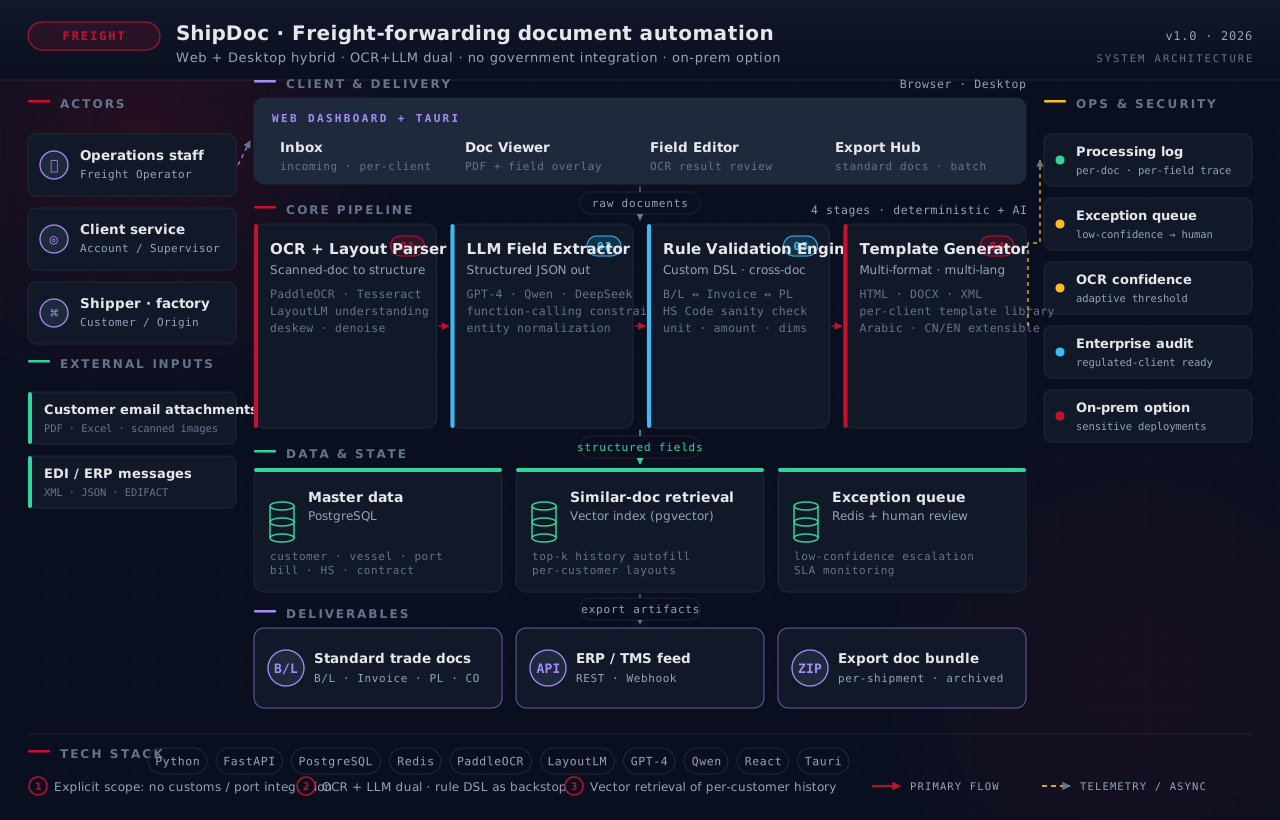
How our approach differs from the alternatives
Before you decide, you probably want to ask
How is it different from customs-declaration software?
Customs software solves the last step — submitting to customs. We handle everything internal before that: from customer email to system-of-record, from Excel to standard documents, from cross-doc reconciliation to exception alerts. We sit upstream of customs software.
Why does being in Dalian matter?
Dalian is the largest port city in Northeast China with a dense forwarder community. That gives us a natural home base for customer interviews, POC partnerships and product co-creation — seed customers will come from this local network first.
Is it affordable for small forwarders?
Subscriptions start around $70/user/month; per-bill pricing lands around $0.15/bill. For a mid-sized forwarder processing thousands of bills a month, labor savings typically pay for the product within 1-2 months.
Give your ops team 2 more hours every day
Tell us your scenario and requirements — a specialist will reach out within one business day with an initial solution sketch and a feasibility read.