
AI-driven web accessibility scanning and one-click fixes
Scan for WCAG, ADA and EAA compliance gaps — don't just report issues, generate fix code and ship Pull Requests.
Why we built this solution
On June 28, 2025 the European Accessibility Act (EAA) took full effect. Every e-commerce, SaaS, finance or transportation website serving EU consumers must now comply with WCAG 2.1 AA. Violations can cost up to €2 million. In the United States, ADA litigation volume has climbed year after year, and cross-border e-commerce is squarely in the line of fire.
Existing accessibility tools (axe-core, WAVE, Siteimprove) mostly tell you what is wrong — not how to fix it. Engineering teams receive the scan report and still have to study and remediate each issue by hand.
Our answer is scan and fix — grounded in code context, the AI generates precise fix patches and can ship them as GitHub Pull Requests. Compliance becomes one commit instead of a legal threat.
Who this is for
Cross-border e-commerce
Sellers active in the EU and US — DTC stores and Shopify sellers
EAA 2025 mandatory, ADA litigation exposure
Outbound SaaS
SaaS products serving European and US enterprises
SOC 2 / VPAT compliance asks from customers
Web agencies
Web build shops and independent developers
Client deliverables must pass compliance audit
Corporate brand teams
Public companies and government websites
Dual pressure from brand image and regulation
The workflows this solution covers
Cross-border e-commerce
- EAA 2025 scanning for Shopify / WooCommerce / DTC sites
- Audit product pages, checkout and cart critical paths
Outbound SaaS VPAT
- SOC 2 / VPAT report generation
- Unblocks the compliance checklist in B2B sales
Agency delivery compliance
- Pre-delivery automated compliance checks
- Issue list and remediation status reporting
Continuous compliance monitoring
- CI/CD integration with auto-scan on PRs
- Regression monitoring so new features don't break compliance
What the workbench actually does
Every capability has been hardened in real projects — not a slideware promise, but engineering that ships to production.
- Broad scanning: axe-core rules + proprietary rules covering all WCAG 2.1 AA criteria
- Multi-regulation mapping: each issue maps to WCAG, ADA, Section 508, EAA and EN 301 549
- Dynamic page support: scans post-login and post-interaction states, not just static HTML
- Code-context aware: connects to the source repo so AI can read component context
- AI fix suggestions: three fix strategies per issue (minimal / best-practice / refactor)
- One-click PR: selected fix is shipped as a GitHub / GitLab Pull Request
- Continuous monitoring: CI integration + scheduled sweeps with alerts on regressions
- VPAT reports: one-click Section 508 VPAT compliance statements
End-to-end system architecture
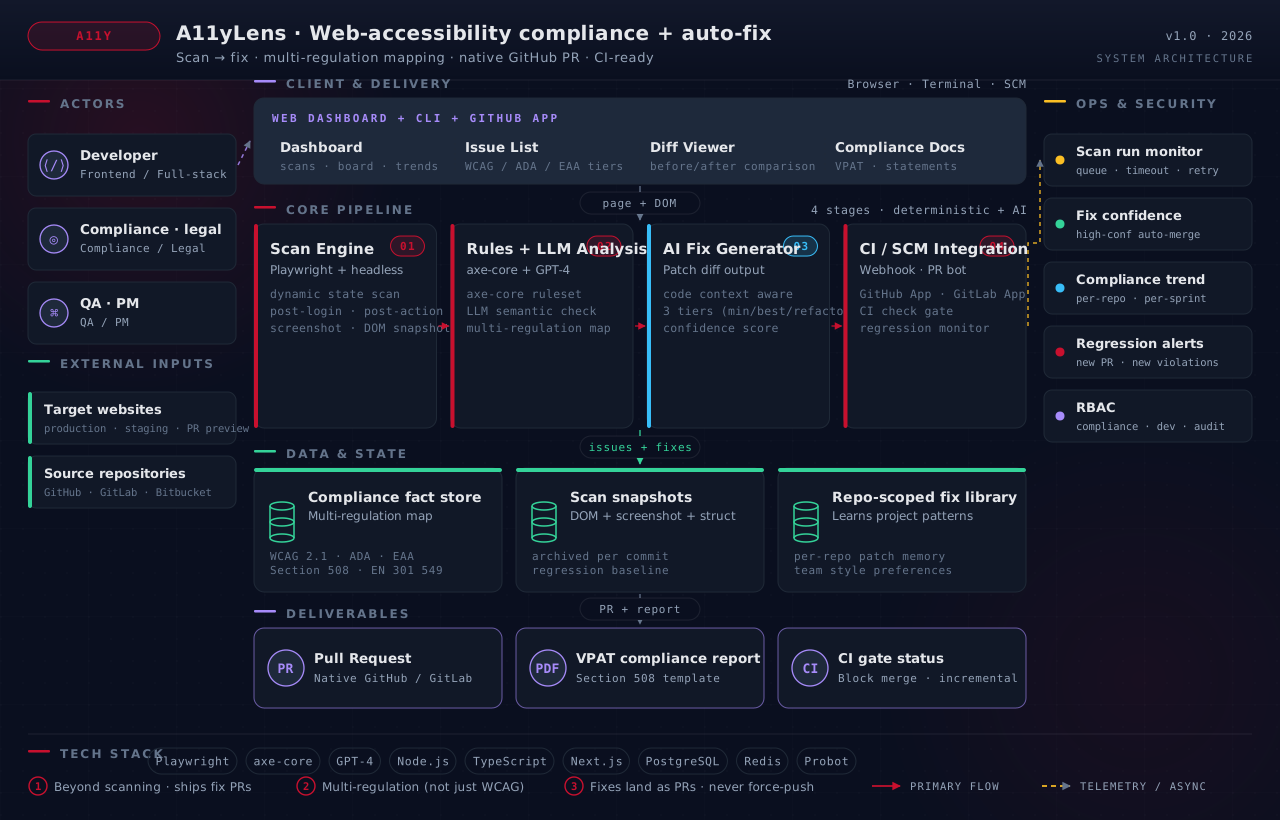
How our approach differs from the alternatives
Before you decide, you probably want to ask
How is this different from accessiBe's AI overlay?
accessiBe injects remediation JS at runtime — an approach the accessibility community has widely criticized as fake compliance and which has drawn lawsuits in the US. We fix at the source level and submit real code changes, which is what sustainable compliance actually requires.
What is EAA 2025 exactly?
The European Accessibility Act took mandatory effect on June 28, 2025. It covers digital products and services across e-commerce, banking, e-books, transport and telecom. Fines can reach €2 million or 6% of annual revenue. Cross-border e-commerce is the first group impacted.
Can AI-generated fixes be wrong?
Every AI-generated fix is submitted as a Pull Request for developer review, so it never lands directly in production. Each fix carries a confidence score — high-confidence patches can be merged in bulk; lower-confidence ones get human review.
Only months left until EAA 2025 takes effect
Tell us your scenario and requirements — a specialist will reach out within one business day with an initial solution sketch and a feasibility read.